Your Caveman Brain
How our prehistoric ancestors still shape the way we live today (Five Founding Cities - Chapter 1.4)

The previous installment of the “Five Founding Cities” narrative can be found here.
Despite the fact that early humans can seem primitive and strange to us, we still have much in common with them. On a genetic level, our bodies, brains, and instincts are still programmed to deal with life as a hunter-gatherer; our modern civilized life of towns and cities is very much not natural to us. From an evolutionary perspective, fifty-thousand years is not very long. There’s a lot you can understand about yourself if you think of your caveman brain as still operating underneath your modern civilized consciousness.
For example, the size of our social circles remains surprisingly similar; we have a small number of very close friends and family who we feel intense loyalty and care for, and a wider circle of more casual friends and acquaintances. Anthropologists have noticed a correlation between brain size and the size of social groupings in humans and primates; larger brains correspond to larger tribes. This correlation is known as “Dunbar’s number,” and for humans, it seems to be about one-hundred and fifty or so individuals that you can reliably count as a friend in “your tribe.” This grouping just so happens to roughly fit the size of many military units, including Roman maniples and WWII infantry companies, and the size of small businesses. Once you grow beyond a hundred to a hundred-fifty employees, you start needing a more regimented bureaucracy to give orders and hold people accountable.
It’s easy to feel intense care and loyalty to someone very close to you, as if they were still part of your hunter-gatherer group. Anthropologically, this is someone you’d be willing to risk your life for in a crisis, because you know that they’d do the same for you. A person with a pure utilitarian outlook might say that, if they were being chased by a bear, the only thing that matters is outrunning the person next to them. But members of a family group will turn and face the bear together, knowing that their overall survival is better with mutual self-sacrifice; you might get away from the bear this time, but next time, you’ll be alone and helpless. Similarly, hunter-gatherers will share food and resources freely within the group; even a skilled hunter won’t always bring back a fresh kill, and will sometimes have to depend on the generosity of others.
This close feeling of intimate friendship and security, however, does not extend outside of your group, which is why we can sometimes feel great pity and anguish for those close to us, but indifference or even callous disregard for the sufferings of “outsiders”. This loyalty for the in-group and disregard for the out-group is probably how nations and governments have historically justified incredible violence and cruelty towards outsiders who “don’t count.” Such tribal loyalties probably also help explain the devotion of sports fans and political partisans towards their own “team,” and why we will so easily excuse or ignore the faults of those close to us, while focusing on the perceived failings of outsiders. The scandals of “our” politicians are rarely as serious as those of our opponents.
The intense loyalty and devotion of a hunter-gatherer group isn’t purely a matter of biological kinship however. While we naturally trust our parents and siblings, we can easily come to regard our friends and closest associates as essentially family. Religious adherents sometimes address fellow members as brothers and sisters, male friends constantly refer to each other as sworn brothers, and college students form fraternities and sororities. You can probably remember movies where close friends swear blood-oaths, or rag-tag bands of misfits learn to put aside their differences, and rely on each other in defeating a common opponent. The ability to forge close relationships and make new family groups almost certainly reflects a history where hunter-gatherer groups sometimes joined together, split apart into colonies, and where outsiders earned the trust of a group enough to be initiated into “the family.”
Some behavioral tropes between male and female humans appear to be biological, and not just learned as part of culture. Generally speaking, men have much more upper-body strength than women, and are more interested in physically-demanding and risky activities. Young men naturally form groups of friends (or even gangs) and sort themselves into hierarchies. They will also attempt to test and demonstrate their strength and courage with feats of (perhaps foolish) daring. In this, their caveman brains are still imagining that killing a woolly mammoth might earn them a place in the group, and the approval of the tribal chieftain.
Women, on the other hand, are generally more adept at understanding nuanced social interactions. Even as infants, young boys are better at tracking movement, while girls are better at reading facial features and interpreting gestures. Women are generally more skilled at reading the social dynamics of a group and understanding who is friends with who, and who isn’t (which could be a life-or-death skill for a pre-modern mother in an unstable social grouping). This is not to say at all that women can’t hunt or fight if necessary. A mother will fight with extreme desperation to protect her children, and some of the most ruthless characters in Shakespeare’s plays are women. In times of necessity, prehistoric men and women must have hunted or gathered together as needed, while also being generally better at their respective roles most of the time.
Food cravings are another caveman legacy. We desire sweet and fatty foods because they were originally rare, but also full of energy (sugars especially would be energy-rich delicacies). One theory about our eyesight, which is very good at seeing colors, is that it adapted in order to recognize ripe from unripe or rotten fruits. Eating large meals is a good idea when you don’t know if you’ll be able to kill another deer in the next week. As a result, our bodies are still wired for a world of scarce nutrition, and require a great deal of training and discipline to handle a modern world of abundant calories artificially flavored with scientific precision to appeal to our taste buds.
Physical health also needs discipline and effort in order to be maintained in the modern world. Hunter-gatherers, as well as pre-modern farmers, were constantly active, with a level of physical fitness that often rivals professional athletes today. Life indoors, sitting all day in front of a desk or on the couch after dinner, has an unprecedented amount of leisure time. We are a bit like astronauts whose muscles atrophy in space, in that we need to constantly work to maintain that which our ancestors had by necessity.
On the other hand, we also have modern medicine, which can address an enormous number of ailments that killed or disabled a huge percentage of our ancestors. Pre-modern skeletons of all types and time periods show a huge variety of chronic health problems and traumatic injuries. Malnourishment, intestinal parasites, joint pain, broken bones or torn ligaments, are all common health problems that pre-modern individuals mostly had to suffer through. An old farmer with arthritis, a bad back, and few family members for assistance might not have had any choice but ever-increasing pain, or hunger.
Danger and stress are another caveman-brain feature not optimized for the modern world (think of our instinctive and irrational fears of darkness, or murky still waters hiding aquatic terrors). A hunter-gatherer would have experienced many life-or-death encounters with wild animals, natural hazards, or other humans, but most of these experiences were likely fleeting and abrupt. As a result, our bodies and minds are adapted for short bursts of very high-intensity stress and effort, but followed by rest in the safety and comfort of a fire surrounded by the group. Today, it can be hard to convince the instinctual side of ourselves that we really are extraordinarily safe most of the time. We can become paranoid or overly worried about trivialities, because we are all descended from paranoid hunter-gatherers who thought that a rustle in the long grass might be a saber-tooth cat (after all, the non-paranoid humans were eventually eaten).
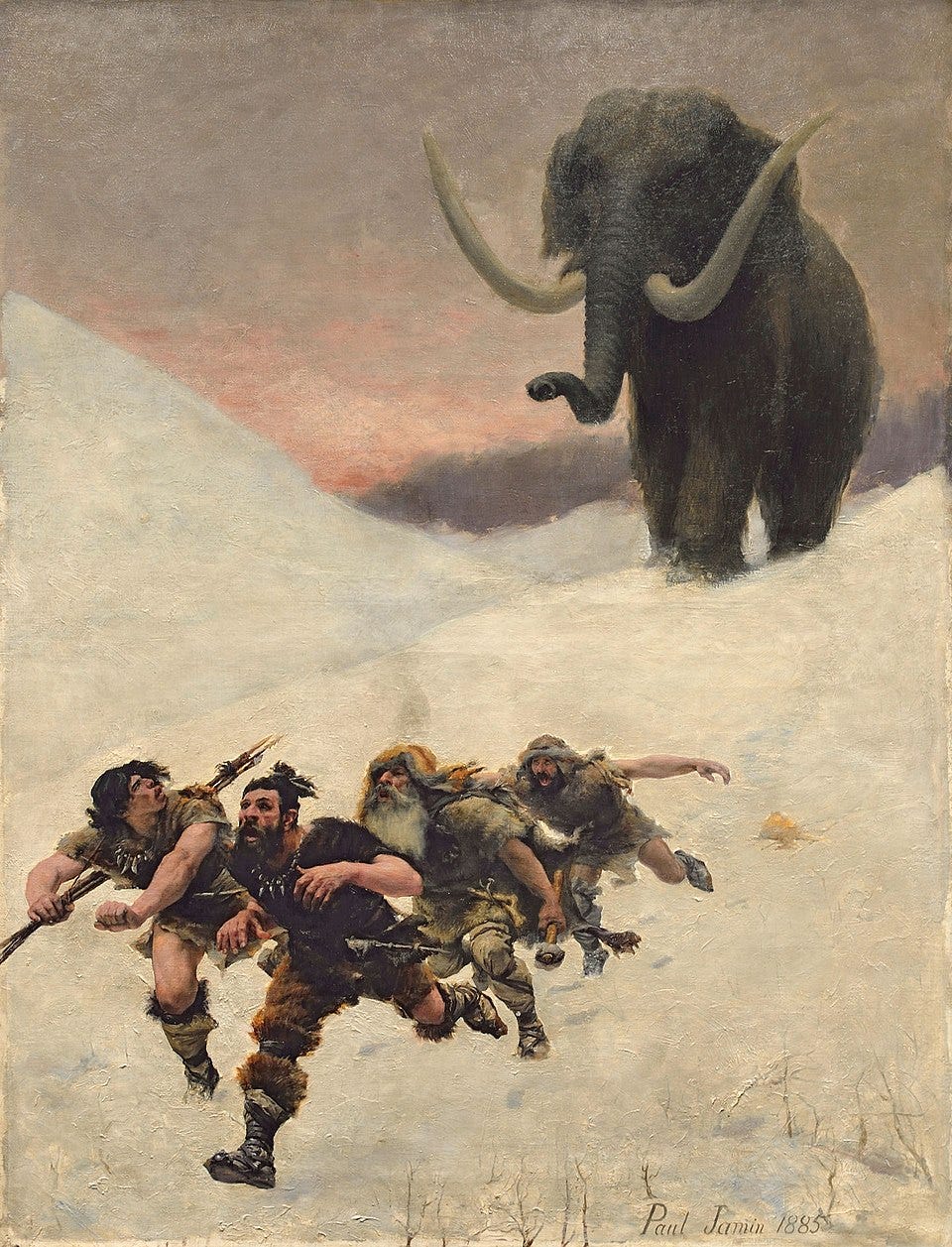

But while the modern world is unprecedentedly safe compared to most of human history, it can be very stressful. School, jobs, and unpleasant social relationships can create lingering and slow-burning stress, which can eventually wear us down without periodic rest and rejuvenation, because our physiologies are wired for short periods extreme effort, and not long-term chronic tension. During WWI and WWII, even the very best and toughest soldiers started suffering from combat fatigue after several months of continuous fighting on the front line. A demanding boss or difficult academic class isn’t actually a saber-tooth cat rustling in the grass, but our caveman brain doesn’t always know that. Just as we need self-control over food, and physical discipline and moral self-control, we must work to build mental toughness and resilience.
This seems to be a theme for humans. We are still very much creatures of nature, but now live in a world of our own making that is no longer very “natural.” Romantics today sometimes express nostalgia for the world that came before the Industrial Revolution, as though humans only recently began remaking their environment. But humans have been changing our environment and learning to adapt and live with the consequences for far longer than the past few hundred years. As we shall see, the greatest example of this may have been the invention of farming itself.
Coming in two weeks; the Neolithic Revolution.