The First Humans
Speech, Art, Death, and Behavioral Modernity (Five Founding Cities Narrative - Chapter 1.1)

This is the next installment in the “Five Founding Cities” narrative. The introductory essay on Western Civilization can be found here.
Ch. 1 - The First Humans
While this work focuses on the Western tradition, we shall not begin with Athens or Jerusalem. Since its focus is on human civilization in the Western tradition, we need to first carve out at least some rough understanding of “human” and “civilization.” This will take us back to the beginning of human history, as best we understand it.
Over the last century or so, if you’d asked a scientist how old humans are, you’d have been told that “anatomically modern humans” first arose around 100,000 years ago in Africa, and then spread across the globe, competing and replacing other early hominids. This was the standard interpretation in archeology and anthropology, and what you’ll still find in plenty of old textbooks.
In recent decades, however, archeologists at Jebel Irhoud, Morocco, have discovered fossils of Homo Sapiens dating back 300,000 years, dramatically pushing back the start date for humans as a species. The Jebel Irhoud excavations are just one of a huge number of archeological discoveries which have significantly reshaped our understanding of early human prehistory. A great many “when did humans first do such and such?” questions have completely new answers from just twenty or thirty years ago, caused by new excavations and methods of analysis. The field of human prehistory is changing so rapidly that the current consensus will probably be out of date in five or ten years time once again. It’s an exciting time to study early humans.
But let’s back up a moment, as we’re getting ahead of ourselves. Just what is an “anatomically modern human?” Or better yet, “what’s a human in the first place?” This question very quickly transcends hard biological definitions about DNA or physiology, and gets into questions of philosophy, culture, and religion. A biologist, philosopher, and theologian might have different answers, and it might be above the purview of a history text to hazard an answer up front. Perhaps instead it’s better to say that a work of history tries to answer the question of “what is a human” in a different (more indirect) way, by sitting back and surveying the landscape of human action across time. Instead of starting with a definitional answer of humanity, and then applying it to the past, let’s withhold judgment and just watch time pass by, and see if human history can surprise and enlighten us. This approach won’t give us as precise or clear an answer as that of a hard science (or theology), and any answer we get will probably be confused, messy, and full of “well we’re not sure” caveats and “but not in this case” exceptions.
In other words, it will be as complicated and contradictory as humans themselves. You yourself are just as messy, complicated, and contradictory as anyone else. Through history, we can come to know other people the same way you get to know a friend or family member over a lifetime of conversations and shared experiences. If done well, we might understand ourselves a little better, and do a better job understanding and predicting how we might act in the future. Compared to the hard sciences, this seems a modest goal, but it can be as rewarding and fulfilling as getting to know a close friend over an entire lifetime.
So, back to these early humans. We can at least say a little bit about “anatomically modern humans.” By this, archeologists and anthropologists mean that, by 300,000 years ago, it seems that Homo Sapiens had developed the physiology of modern humans in terms of their skeleton and muscular structure. In theory, if you could revive one of those humans from Jebel Irhoud and clean them up a bit, they’d look and move recognizably like us.
But what about the eyes? If you looked one in the eye, would they really look and “feel” like us, and could they have a conversation with us? This is harder, and more unknown. It’s likely that these anatomically modern humans weren’t yet behaviorally like us. A scientist might say they hadn’t developed the mental capacity, and a philosopher or theologian might say that they didn’t have a soul. On this question of what anthropologists call “behavioral modernity,” you might be surprised to find out that there’s more agreement with science and the world’s major religions on this point, as we’ll try to eventually demonstrate. A running theme of this text will be an attempt to not pick sides between science and religion, but show where science and religion are often trying to ask and answer some of the same questions.
“Behavioral modernity” describes the point at which anatomically modern humans really became “human” in a fuller sense of the term, and clearly distinguished themselves from other primates and animals. At this point, a prehistoric human wouldn’t have just looked like us, but in theory could have also talked, acted, thought, and felt like us. Broadly speaking, we can identify three main traits of behavioral modernity:
Symbolic Speech: Many animals communicate with each other with movements, smells, calls, and actions. Humans seem to take communication further by encoding abstract thoughts into sounds, which can be “decoded” by a listener and understood. Some primates have been taught sign language, but it’s likely that this is more of a very advanced form of pattern recognition. While many words sound vaguely or even clearly onomatopoeic (the word “sizzle” sounds like a hissing skillet), humans can use speech to express incredibly abstract mental concepts.
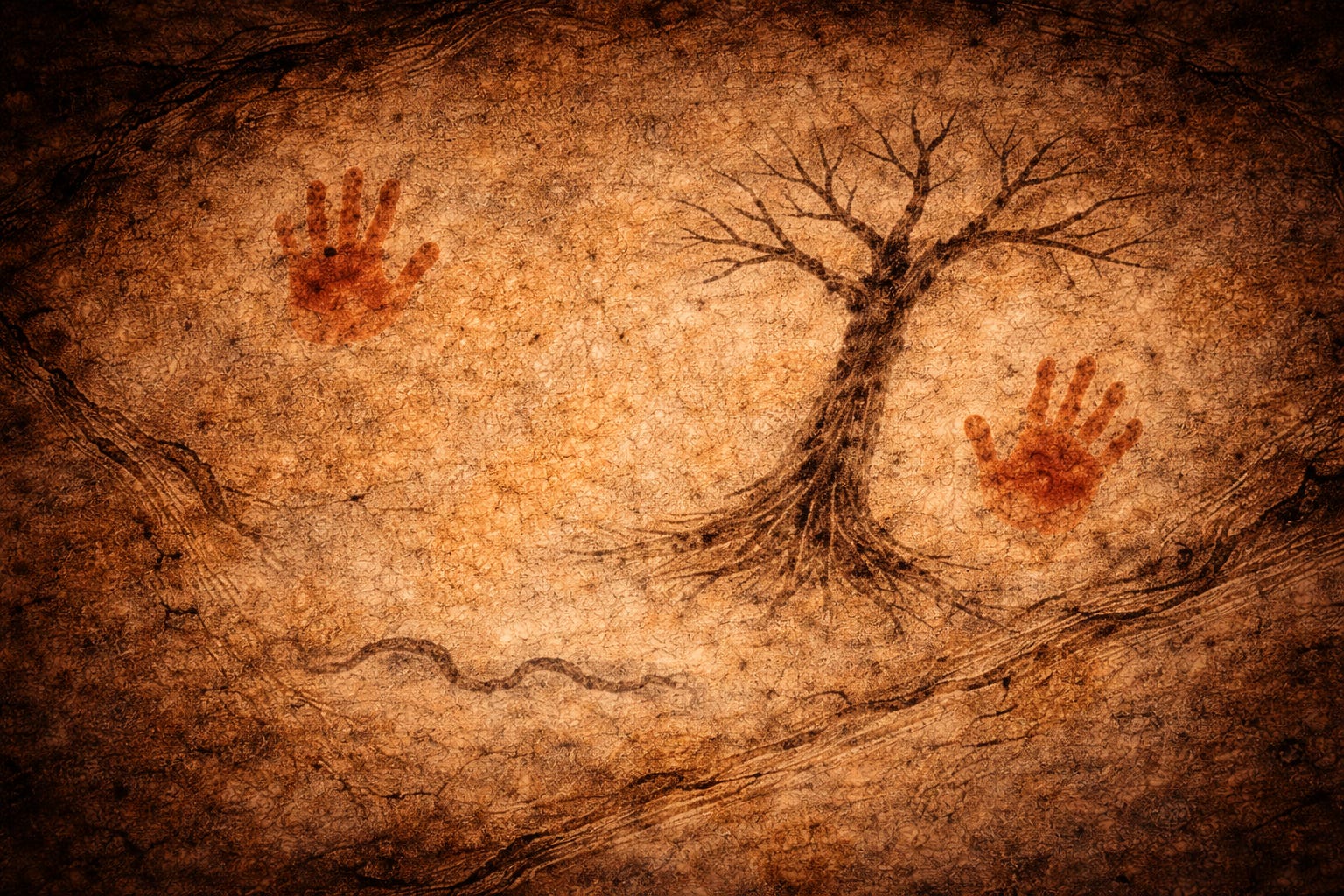
Art: Humans are engaged in creative activities which serve little or no apparent practical purpose, or which, in addition to some purpose, are done mainly for enjoyment. A seashell necklace or facepaint does not directly help someone acquire more food or resources, but it might look beautiful or meaningful. Artistic expression such as paintings, songs, or stories, might have instructional value or edification, but the best works of art reach a level of aesthetic enjoyment; many works of art are ruined by trying far too hard to “teach you something.” The best art is simply enjoyed and appreciated. If you think about your average day, it’s likely that very little of what you do is ordered around sheer survival in the animal sense. You could live as well as a wild animal in a log shelter while wearing a burlap sack and foraging for nuts and berries, but instead we spend the bulk of our time, effort, and resources pursuing, making, and using food, clothes, and objects which bring meaning and happiness to us.
Ritual burial: Humans bury their dead, often with great ritual and ceremony. It’s unclear how much other animals are even aware of death, although they experience fear and pain. Elephants seem to mourn their dead in some way. But most humans wash, clothe, and bury their dead with objects, accompanied by elaborate ceremonies and rituals. Even non-religious humans who express no belief in an afterlife will attend funerals and reverently commit caskets to the earth. Humans close the eyes of their dead, and are uneasy around uncovered corpses. A body remains, but something “human” is gone.
Together, speech, art, and awareness of death seem to create a package of traits that separate humans from other animals. However humans came to exhibit these traits, they represent something distinct and profound; a switch flipped on inside that makes us “human” in more than a chemical and biological sense.
This anthropological understanding of humanity may have more in common with religious depictions of humanity than we might suppose. Consider the creation account in Genesis, in which God speaks the universe into creation, and talks to himself in the plural, saying “let us make man in our own image.” One of the first things man does in Genesis is give names to all the animals, and the major consequence of the Fall after Adam and Eve eat the fruit from the Tree of Knowledge, is death. Also, as soon as Adam and Eve eat the forbidden fruit, they immediately become aware of themselves in a new way, and make clothes out of fig-leaves.
Right away in Genesis, then, we have Creation itself associated with the act of speech and plurality; talking makes no sense if you don’t have someone to talk to after all. Adam names the animals, an act both of speech and art, and part of the consequence of gaining knowledge, is awareness of nakedness and the making of the first technology; clothes. Finally, this knowledge brings with it death.
There are other aspects of the Genesis story that harmonize surprisingly well with an anthropological and biological account of human development. Consider the serpent as the enemy of mankind, and especially mothers. If early hominids once lived in trees in Africa, then snakes would have been one of the few predators able to threaten humans; imagine sleeping on a tree branch and waking up in the middle of the night and seeing the eyes of a snake moving towards you. This may be why so many humans even today find snakes unnerving. Likewise, if early humans spent lots of time foraging and gathering nuts, berries and roots, you can imagine how often turning over rocks and logs might have led to unpleasant encounters with serpents. And this work was generally done by women, often accompanied by small children. In Genesis, God declares that the serpent and the woman would be naturally enemies of each other; the snake striking at the woman’s heel, and the woman trodding on the snake’s head.
Next time, why humans have big brains and no hair. Coming in two weeks. Thank you for reading.
Thanks for writing this, it clarifies alot! It's so cool how our understanding of human history keeps evolving. Kinda like debugging a super old, complex code base, always new data!
Much appreciation for this! Looking forward to these installments! Beautifully written! 👏