
I did not expect a post on the Thirty Years War, of all things, to serve as a breakout piece for this blog. But perhaps it makes sense that bewilderment at the complexity and contradictions of the war would resonate. In more than one sense, it’s nice to know I’m not alone. Sincere thanks to all who have read, shared, and commented.
Blog update: I have several pieces in the works, and maybe even some audio of an in-depth discussion of the Odyssey (book, not movie). However, my wife is going through a rough first trimester pregnancy at the moment, and has needed a little extra help here and there.
Several comments expressed interest in what books I used or would recommend in order to understand the Thirty Years War, and I had already been thinking about a follow-up post comparing and contrasting a pair of books in particular. So here’s how I tried to understand the Thirty Years War.
I came out of college with a very rough sense of the conflict, and cobbled together a bit more of an understanding in my early years as a teacher (there’s nothing like the pressure of having to teach something in order to make you learn it yourself). At some point I ended up reading a few of the Eric Flint 1632 series of alternate history, which I’ve written about before. These what-if novels follow the premise of a small West Virginian coal mining town being transplanted to Thuringia in the middle of the Thirty Years War, and as ridiculous as the premise is, the series is a fantastic meditation on what technologies and institutions helped create the modern world (it turns out that the average American public high school in the late 1990’s probably had enough knowledge to basically start the Industrial Revolution). The series quickly separates from the original historical timeline, as the “up-timers” from West Virginia start changing events, but the books are well-written, have memorable characters, and give you a visceral sense of the flavor of the mid-17th century.
A few years ago, I decided I really wanted to focus on learning the Thirty Years War once and for all, and I ended up choosing two separate histories to go through. I’ve now read/listened to C.V. Wedgwood’s The Thirty Years War (1938) and Peter Wilson’s Europe’s Tragedy: A History of the Thirty Years War (2009), and I’ve made it through both books twice.
But before I go into each of the two histories, there was another angle to the conflict that I studied, mostly in passing, which ended up making an enormous difference in studying the Thirty Years War. In a few separate sessions over the last year and a half, I used ChatGPT to help teach me the geography of Germany and central Europe. This alone was the easiest and highest-value lever I found, even though I wasn’t really thinking about the Thirty Years War specifically, but in the moment was merely exercising personal curiosity. One thread in particular a few months ago that started with “what is the significance of Wroclaw?” turned into a hugely beneficial discussion of Germany’s regions. It’s also a good example of how I used GPT as a tutor to stress-test my understanding.
Geography unlocks the conflict
German geography is a nightmare. It’s one big landmass, and there aren’t peninsulas or dramatic coastlines to use as major reference points. Instead of central nodes, there are instead a myriad dispersed locations in the form of rivers, mountains, forests, and cities and regions. Many times I’ve read military history accounts and been bewildered by the locations and routes of armies moving across medieval and early modern Germany (how does Mecklenburg connect to Pomerania connect to Saxony connect to Silesia?). The geography of the region goes a long way to explaining how the Holy Roman Empire’s political and social structure was so fractured and convoluted. But it also reveals how different medieval Germany was from the later nation-state that was built out of Prussian militarism and 19th century nationalism.
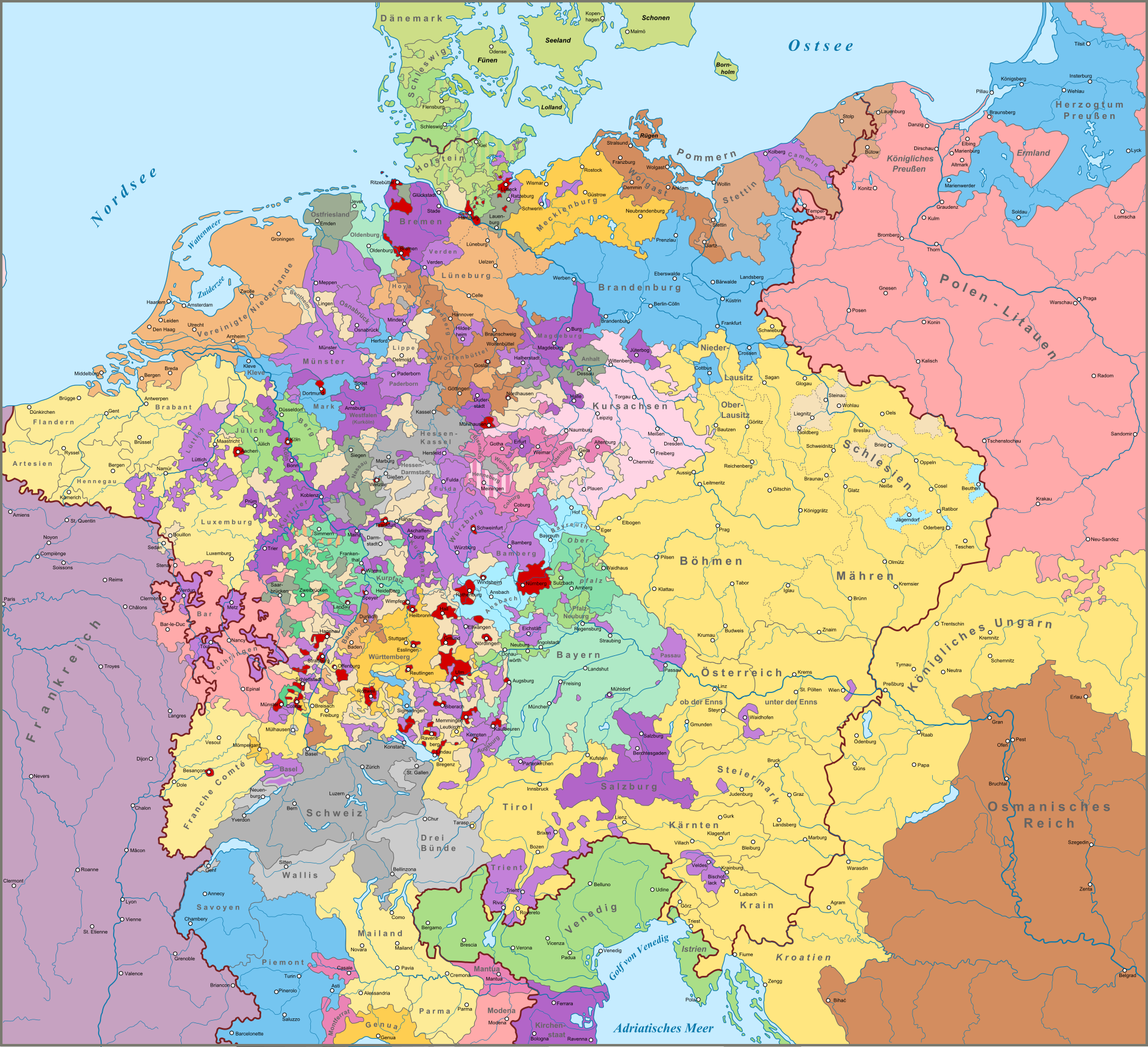

Germany doesn’t have one capital region in the way that France, England, or Russia are dominated by a ruling city and its immediate environs. Instead, Germany is more like America in that it has multiple interlocking zones, each with their own regional geography and culture. Politically, feudalism made this even more complicated, because territories often became linked due to inheritance and dynastic rights, rather than pure topographic logic. The Palatinate contained lands along the middle Rhine, and separately in Eastern Germany (although this was called the Upper Palatinate). Saxony is something of a moving target in terms of what time period you’re focusing on. Brandenburg is in Northeast Germany, but acquired the separate holding along the Polish coast known as ducal Prussia, which later came to subsume Brandenburg proper (and then the rest of Germany in the 19th century).
And then you have the cities, which are their own category, and have their own confusing identities and political allegiances. There are two Frankfurts, one on the Main and one on the Oder. Many cities were ruled as Bishoprics, reflecting traditions running back to the late Roman Empire and Early middle ages when bishops were de facto city magistrates in the absence of other strong political institutions. Over time however, many growing towns purchased their freedom from feudal lords and became Imperial Free Cities. In Northern Germany and the Baltic, this led to the golden age of the Hanseatic League of mercantile city-states. German cities became huge centers of commerce for Germany’s considerable natural resources and trade routes which connected the rest of Europe. There’s an entire tradition of medieval and early modern civic urbanism across Northern Europe that was just as dynamic as Greek poleis culture or Italian republicanism, but which is often invisible to modern audiences because of the legacy of the absolute monarchies and later nationalism.
It turns out that the key to unlocking this bewildering array of geographic regions and polities is Germany’s rivers, which both explain how different parts of Germany are connected, and give you a mental anchor to memorize around. This is also the key to teaching geography to students; reducing the absolute number of items to memorize, and scaffolding around key zones and concepts. Once I started working off the river network, things started clicking. GPT was significantly useful here for explaining the rivers, and then helping quiz me to test my understanding.
Germany is an L, shaped by the Rhine and Danube rivers, which both originate in South-Western Germany, along the Alps and Black Forest. This is roughly the province of Swabia. The Rhine flows North, ultimately out through the Netherlands, and, like Egypt’s Nile, has the confusing property of possessing upper (in the South) and lower (in the North) zones, but which also have a network of tributaries flowing from France and Central Germany. The Rhine region is incredibly dense, with trade cities, bishoprics, and small-but-wealthy principalities that constantly look towards Switzerland in the South, France in the center, and the Netherlands or Saxony in the North. This is where provinces and cities such as Alsace-Lorraine, the Franche-Comté, Heidelberg, Strasbourg, Mainz, and Cologne are found. The famous Spanish road sent men and money up from Genoa and Milan across the Alps, near Lake Constance in Switzerland, and into the upper Rhine region, for the long trek down (North) to the Spanish Netherlands.
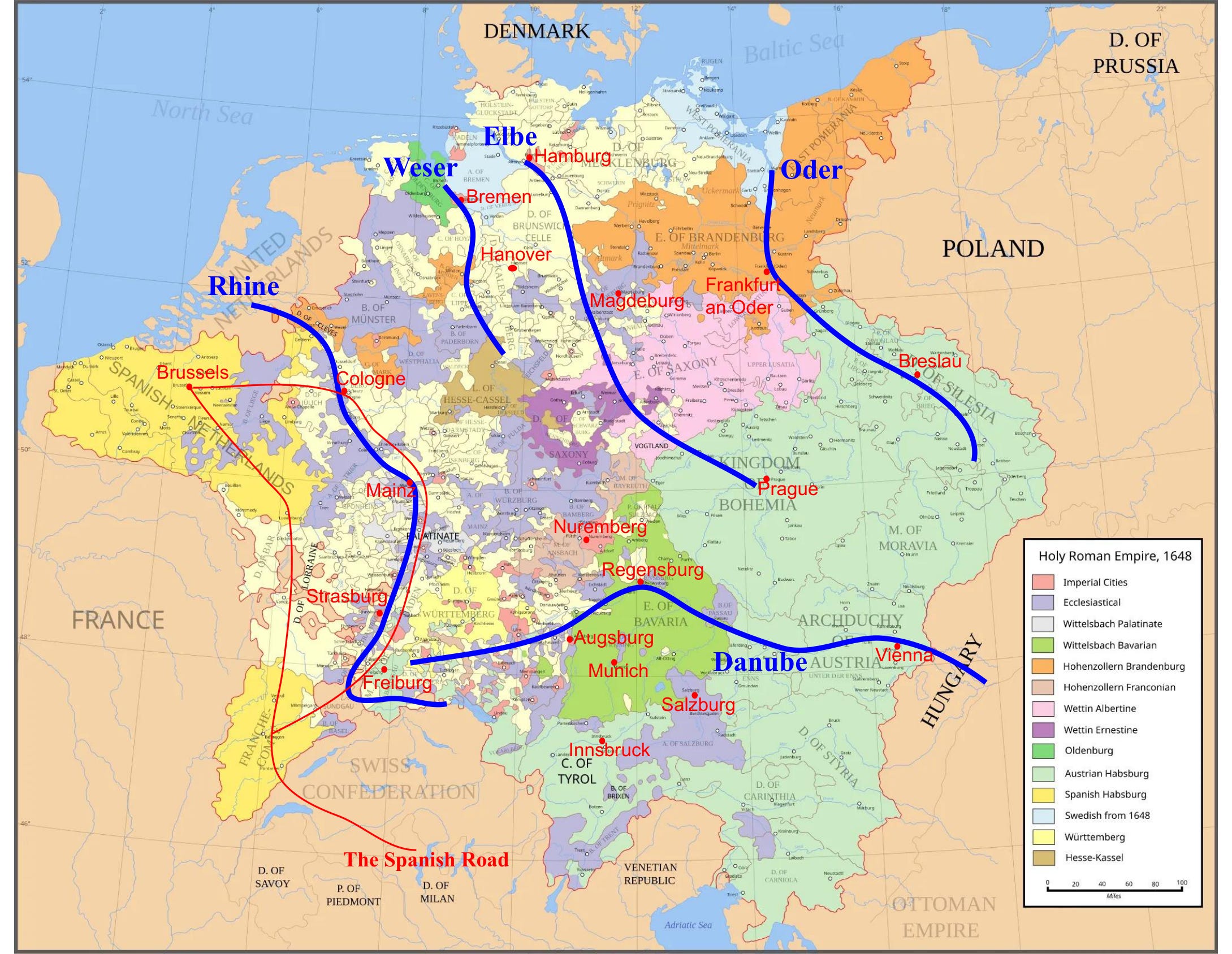

The Danube flows East, through Southern Germany and Austria, and on through Eastern Europe towards the Black Sea. Once you remember the network of the Danube, you can understand how Bavaria (Regensburg) is linked to Austria (Vienna), which is linked to Hungary (Budapest) and Transylvania. Famous cities such as Munich, Augsburg, Innsbruck, and Salzburg connect to the Danube through tributaries. The Tyrol region of Austria links down to Venice and the Adriatic.
East of the Rhine, Germany is cut by three riverine corridors around the Weser, Elbe, and Oder, all flowing South to North, and linking central Germany to the North Sea and Baltic coasts. The Weser gives you Thuringia, Westphalia, Hannover and Bremen. The Elbe is extremely important, running from Bohemia and Prague up through Dresden, Saxony and then Hamburg. The Oder connects Silesia, Breslau/Wroclaw, Frankfurt on the Oder, and Pomerania on the Baltic coast. There’s a hybrid zone of provinces (Bohemia, Moravia, Silesia) in this region that shifts back and forth between German, Czech, Polish, and Austrian influence over time (this is the area Hitler used to escalate his early land-grabs in the runnup to WW II).
There are famous mountains and forest regions of Germany, but the rivers are the skeleton key, and explain why Germany has been so hard to unify going all the way back to the Germanic tribes described by Tacitus. Germany’s rivers make corridors, but they don’t link together as a unifying force in the same way that the Nile or Mississippi do. They provide trade flows from the South to the North, but they can be dominated by high castles atop hills and ridges at a thousand places, giving rise to medieval robber barons and political veto power against centralized authorities. And while the Rhine is the most famous German river, its tributaries and fractured local communities have made incursions and meddling from France a tradition dating back to Caesar’s famous Rhine crossing. This probably helps explain the oddity of Charlemagne being the Frankish founder of the Holy Roman Empire, as well as Napoleon causing its dissolution.
I still wouldn’t call myself comfortable with German geography, as there are still a host of smaller rivers and principalities, but once you can start mentally grouping the country into regions and riverine zones, you can at least start tracking different names and interests when historical accounts keep throwing a dizzying array of place-names at you. Although I still don’t think I understand the swing role of figures such as Amalie-Elizabeth of Hesse-Kassel in the war.
Anyway, on to the two main books I used to help me understand the Thirty Years War, and what they demonstrate about how historical writing has changed over the last century.
Wedgwood and Wilson
C.V. Wedgwood (Dame Cicely Veronica) was an English historian who specialized in 16th and 17th century England. Wedgwood published her most famous work, The Thirty Years War in 1938, when she was only 28 years old. This was astonishing accomplishment given the scope, depth, and maturity of the work, which has the poise and confident analysis of a far older and maturer historian. Wedgwood’s prose and command of historical irony is brilliant.
Reading Wedgwood, you are repeatedly reminded how literary the best historical writing was nearly a century ago. Wedgwood reminds me of sterling prose-historians such as Samuel Eliot Morison, T.R. Fehrenbach, and of course, Barbara Tuchman. Very frequently, Wedgwood’s use of irony is Gibbonesque in building up a theme, character, or event, and then in one final clause, twisting the knife:
“The underlying cause of the demand for a voice in politics was thus not so much the principle of liberty as the desire for efficient government. Theories of right and wrong, of divine ordination or the innate equality of men, formed the rallying cries, the symbols for which men died with profound sincerity, a king of England by the axe no less than an Austrian peasant on the wheel. But success or failure in the end depended on the efficiency of the administrative machine. Few men are so disinterested as to prefer to live in discomfort under a government which they hold to be right rather than in comfort under one which they hold to be wrong. Representative government in Bohemia failed because it was signally worse managed than the despotism it replaced, and the Stewarts fell not because Divine Right was unsound but because their government was incompetent.”1
Wedgwood’s prose skill is matched by her ability to develop a character and portray historical figures with depths of insight, grace, and tragedy. She clearly enjoys her subjects, even when deriding them and pointing out their hubris and reckless folly, as in Frederick of the Palatinate and his hopelessly overmatched advisor, Christian of Anhalt. She is at her very best when painting the life, morality, earnest faith, and hubristic zeal of characters such as Ferdinand II, who truly convinced himself that Austria’s dynastic interests were one and the same as those of the Catholic Church, and that his recatholicization program in Austria and Bohemia was a divine vocation. This zeal drove him to issue the Edict of Restitution, which radicalized moderate Protestants and opened the door to Gustavus Adolphus’ invasion, prolonging the war and causing another two decades of suffering and misery.
Here’s how Wedgwood compares Ferdinand II with his son, Ferdinand III:
“The King of Hungary had inherited his father’s good nature but without his lightness of heart. He had inherited also much of his father’s charm. Less garrulous, he was more dignified and not less gracious, and his ability to converse easily in seven languages gave him power to undertake much of his own diplomacy. In appearance he favoured his mother’s family and had the melancholy dark eyes, brown hair and strong features of the Wittelsbach…He was quiet, thoughtful, rather melancholy. Unlike his father he was economical to the point of meanness. As a boy, his reserve had made him appear dull-witted, but as he became surer of himself he gave the impression instead of being a profound thinker. Profounder indeed than he was, for when all is said, he was only a decent, imaginative, worried intellectual. He had neither the intense faith in his mission nor the trust in his God which bore up his father; he had not the singleness of purpose which gave the old Emperor a touch of greatness. He was too clever to be happy, not clever enough to be successful. Ferdinand II was either very shrewd or very lucky; Ferdinand III was neither.2
You can tell that Wedgwood came from a milieu where great literature was still widely read and emulated as a model of capturing the human condition. In the last analysis, Wedgwood lays the blame most chiefly on Maximilian of Bavaria and John George of Saxony, as the two supporting characters on either side who chose personal gain when they could have urged compromise and helped stabilize the empire. Ferdinand, Gustavus, and Richelieu were men of destiny driven by their positions and ambitions, and could hardly do other than obey their nature and position. But Maximilian and John George had a choice, and made the wrong one. Wedgwood’s history is Shakespearean.
Peter Wilson’s Europe’s Tragedy: A History of the Thirty Years War is an entirely different book, though it is also a remarkable accomplishment. Wilson is a veteran historian of Germany and central Europe, specializing on the Holy Roman Empire, and his expertise shows. As he remarks in his preface:
“The history of the Thirty Years War is rich in specialist studies, but poor in general accounts. Few authors provide more than short overviews intended for students. It is easy to see why. To cover all aspects would require knowledge of at least fourteen European languages, while there are sufficient archival records to occupy many lifetimes of research.”3
He then moves on, without telling you just how many of those languages he knows and how many archives he’s familiar with. But the unspoken implication remains, and Wilson proceeds to deliver. The book is over a thousand pages, and covers the constitutional structure of Germany, the military and economic institutions of the war, and provides solid overviews of every major country involved, including a lengthy chapter on 17th century Denmark, Sweden, and Poland-Lithuania. Wilson does not focus only on events in Germany, but briefly covers the Dutch revolt and progress of the Eighty Years’ War, gives you the long decline of Spain across the first half of the 17th century, as well as colonial events in the Atlantic and Caribbean. This is very much a book that’s aware of today’s global and international early modern historiography.
The end result is a book that is relentlessly thorough and methodical, though not very exciting. It is at least clearly written (mostly), and reflects an emphasis on methodology, archival research, context, and caution about bias and limited perspective.
I sometimes wonder if older histories were sometimes more imaginative and better written in part because they had fewer (but also literary) sources to work with. For instance, Wedgwood and Wilson both give you a competent overview of Albrecht von Wallenstein, but when Wedgwood introduces Wallenstein, she uses portraits:
“He was not a popular man; tall, thin, forbidding, his face in the unexpressive portraits which have survived is not prepossessing. No great master painted him and the limners who attempted his saturnine features agree only in a few particulars. The irregular features, the high cheek-bones and prominent nose, the heavy jowl, the thick, out-jutting underlip—these are present more or less in all pictures. Later portraits exploited the dramatic possibilities of that strangely unsympathetic face, for when Wallenstein became great there was no detail of his conduct or appearance that did not become common property—his ungovernable temper, his disregard of human life, his unsteady nerves, his immutable chastity, his faith in astrology…In his pale, dry face the equally vivid colour of his lips may perhaps not have been nature’s work alone. But stripped of the character he later created, what was Wallenstein in 1623 but an unscrupulous and able careerist?4”
Elsewhere, Wedgwood describes Bernhard of Saxe-Weimar’s “low forehead, hard, unimaginative eyes and mean, egoistic mouth.”5 Wilson, in contrast, gives you a solidly-workable character sketch and biography of Wallenstein, and then discusses the “Wallenstein problem” in contemporary scholarship, which includes Freidrich Schiller’s trilogy of plays on the man, as well as German and Czech nationalist historians attempting to turn Wallenstein into a hero.6
After the battle of Rocroi, Wedgwood eulogizes Spain and the Tercios as “the end of the Spanish army. They had not lost their reputation at Rocroy, as the Swedes had done at Nördlingen, but they had died to keep it…the gravestone of the Spanish army; almost, one might say, the gravestone of Spanish greatness.”7 Wilson blandly tells you that Rocroi owes its exaggerated fame to French propaganda and Condé’s self-promotion, which ultimately helped ensure Rocroi’s place in later military staff college syllabi.8 Wilson gives a similar treatment to Gustavus Adolphus, though without completely attempting to handwave away his real skill and charisma.
Wilson’s overall argument is that the war was not inevitable, and not even primarily religious. Instead, the empire had done a relatively effective job brokering compromises in the past, and that contingent events conspired to break the conflict open. However, despite his claim that religion was not the main driver of the conflict, Wilson is suspicious of militants and zealots, and his ending analysis has a wan and not-very-original warning about the dangers of extremism.
Wilson is probably at his best as an expert on the constitutional order of the Holy Roman Empire, which makes sense given that he’s also written one of the most widely regarded histories of the Holy Roman Empire and medieval Germany (I tried to listen it almost a decade ago, and only made it about halfway, as it’s even more dense, and organized on structural themes rather than as a narrative). Wilson can sympathetically explain just how and why the HRE was such a convoluted edifice of political estates and jurisdictions, and he cites an 18th century German lawyer who attempted to explain the Imperial constitution, only to give up after publishing a hundred volumes.9 For Wilson, the lumbering mess of estates, diets, courts (the Reichskammergericht imperial chamber court is about as easy to understand as it is to spell), and the empire’s deliberate habit of moving slowly and leaving ambiguity in important decisions, were all features, rather than bugs, because they allowed room for negotiation, deliberation, and compromise across Germany’s three-hundred some-odd principalities. For Wilson, this enabled the Holy Roman Empire to successfully navigate conflicts over time and avoid fracturing, while allowing emperors to retain considerable authority and influence through the majesty of their office and person. You can see why later 19th and 20th century historians, who assumed that efficient state-formation was the proper development in capital-H History, thought the empire was an outdated dinosaur, and why Wilson thinks they’re wrong to do so.
The point about 19th century historians is one that comes up again and again in Wilson’s book, which is another one of its most useful features. Part of the reason the book simply isn’t as enlivening to read as Wedgwood, is that Wilson is explicitly aware of what came before, and constantly refers to previous historiographic interpretations, before pivoting to a new one. The book also often wants to emphasize distance rather than familiarity, and Wilson has the slightly annoying habit of not updating names to modern English sometimes. John George of Saxony becomes “Johann Georg.”
Though my sample here is limited, my strong impression is that many good histories from the last few decades are now able to draw on a wide variety of archival sources and data, that, while not ignoring older literary sources, don’t solely rely on them. While there’s obviously a culture-war angle here about historical revisionism and activist scholarship, the controversial examples probably get all the attention, and obscure a whole bunch of boring-but-useful trends that are a net positive for historical understanding. I’ve seen this with historians such as Peter Heather (Fall of Rome), Warren Treadgold and Anthony Kaldellis (Byzantine History), Chris Wickham (Middle Ages) and Peter Marshall (English Reformation).
Often, this means drawing on seemingly anodyne and dull information such as land and tax records, parish registries, wills, commerce data, and climate and environmental science. One of the most vivid examples to me was reading Peter Marshall on the English Reformation and pre-Reformation fears of clerical corruption, which Marshall was able to cross-check by surveying the actual number of reported complaints levied against parish priests by the laity (not as many as you’d think based on the accounts of both protestant reformers, and elite humanists such as Thomas More and Erasmus). This type of archival investigation pops up frequently in good historical writing, and isn’t inherently ideologically motivated. I know some folks in classical education and conservative spaces sometimes have an understandable suspicion of new historical scholarship, but a reflexively hostile attitude may not always be the best approach.
Wilson is able to draw on wide amounts of such research and bring it to bear on everything from the population levels of Castile, to Swedish military conscription, and how exactly the Habsburg program of recatholicization in Bohemia and Austria worked, in terms of whether protestant nobles converted or emigrated away. One of Wilson’s strongest overall chapters is on the economic and demographic effects of the war, looking at tax records, census data, and lots of previously overlooked civilian letters and diaries.10 It turns out that plague was probably the number one cause of mortality in the whole war, and that some percentage of the worst accounts of atrocities and even cannibalism often end up being second and third-hand rumors which may have grown some in the telling. The war’s destruction was also often concentrated along key communication routes and corridors, which were naturally more visible to travelers and spectators, helping somewhat exaggerate the image of devastation in popular accounts. That doesn’t at all mean that the war wasn’t a catastrophe, just that some of the very worst estimates from scholars a century ago were probably overblown. Even modern low-end estimates of a 15% all-cause mortality in Germany would be higher than that of the Soviet Union during WW II.11
So then, I used GPT for the geography, Wilson for the institutions and political topography, and Wedgwood for the Shakespearean tragedy. I shall give Wedgwood the last word (but with Wilson clearing his throat and muttering about the reliability of third-hand accounts), describing the death of Ferdinand II in 1637:
He had a tranquil death-bed, propped up among his pillows, fortified by the comforts of the Church, smiling from time to time peacefully at his wife and younger daughter watching by him. In eighteen years of struggle he had never lost confidence in his mission, or in God and at the end he could say ‘Nunc dimittis’ with full contentment, for he had indeed achieved a large measure of his ambition. He had not altogether won back Germany from the heretic, but at the Peace of Prague he had asserted the right of the Church to all she had held in 1624, and this, with the purification of Austria and Bohemia, was a gain of which he might justifiably be proud. At Linz that very year, the sight of the converted people flocking into the churches had moved him to tears of thankfulness. For the rest, he had reunited the Austrian dynasty within itself, grafted it by the marriage of his son to the Spanish tree, successfully reformed the administration of his own lands, destroyed the League and the Union and united most of the ruling princes, whether they would or no, beneath his controlling sceptre. It was an achievement which, seen in the light of his political morality, he might present at the judgement seat of God with a certain modest satisfaction. No qualm of doubt seems to have troubled the calm with which he prepared for his last account. On February 15th at nine in the morning his body and soul parted one from the other, the one to moulder in the vaults of Graz, the other to receive the reward for which he had laboured so long.12
And then she twists the knife:
His political achievement had cost dear for what it was, too dear had he ever stopped to reckon the cost. On paper, imperial authority might be paramount in Germany; in fact the soldiers alone ruled. The soldiers, not the generals; Baner frankly admitted that he had not the slightest control over his men, and tales were told of the sack of Kempten by the imperialists, of Landsberg by the Swedes, of Calw by the Bavarians, which froze the blood. The imperialists had slaughtered children in the cellars, thrown the women out of the upper windows of the houses and boiled a housewife in her own cauldron. The Swedes had sprinkled gunpowder on their prisoners and set fire to their clothes, the Bavarians under Werth had shut the citizens into Calw, fired the walls, trained guns on the gates and shot at the people as they tried to escape the flames. The stories were exaggerations but based on the increasing and now general barbarity of the war. In sober fact, civilian prisoners were led off in halters to die of exposure by the wayside, children kidnapped and held to ransom, priests tied under the wagons to crawl on all fours like dogs until they dropped, burghers and peasants imprisoned, starved and tortured for their concealed wealth to the uttermost of human endurance with the uttermost of human ingenuity.
Wedgwood goes on like this for several more pages, describing the devastation of central Germany, the masses of fugitives, and the multiplication of rats in deserted cellars which “devoured the grain which the soldiers left, and ruined the harvests.” And then:
The fugitives who fled from the south after Nördlingen died of plague, hunger and exhaustion in the refugee camp at Frankfort or the overcrowded hospitals of Saxony…at Strasbourg they lay thick in the streets through the frosts of winter, so that by day the citizens stepped over their bodies, and by night lay awake listening to the groans of the sick and starving until the magistrates forcibly drove them out, thirty thousand of them. The Jesuits here and there fought manfully against the overwhelming distress; after the burning and desertion of Eichstätt they sought out the children who were hiding in the cellars, killing and eating the rats, and carried them off to care for and educate them; at Hagenau they managed to feed the poor out of their stores until the French troops raided their granary and took charge of the grain for the army.
…At Calw the pastor saw a woman gnawing the raw flesh of a dead horse on which a hungry dog and some ravens were also feeding. In Alsace the bodies of criminals were torn from the gallows and devoured; in the whole Rhineland they watched the graveyards against marauders who sold the flesh of the newly buried for food; at Zweibrücken a woman confessed to having eaten her child. Acorns, goats’ skins, grass, were all cooked in Alsace; cats, dogs, and rats were sold in the market at Worms. In Fulda and Coburg and near Frankfort and the great refugee camp, men went in terror of being killed and eaten by those maddened by hunger. Near Worms hands and feet were found half cooked in a gipsies’ cauldron. Not far from Wertheim human bones were discovered in a pit, fresh, fleshless, sucked to the marrow.13
C.V. Wedgwood, The Thirty Years War, New York Review Books, NY, (Originally published 1938). Amazon Kindle edition, pg. 19.
Wedgwood, Kindle edition, pg. 353.
Peter Wilson, The Thirty Years War: Europe’s Tragedy, Belknap Press, Cambridge MA, (2009), Amazon Kindle edition, pg. 23.
Wedgwood, Kindle edition, pg. 166.
Wedgwood, Kindle edition, pg. 356.
Wilson, Kindle edition, 536.
Wedgwood, Kindle edition, pg. 444.
Wilson, Kindle edition, pg. 891.
Wilson, Kindle edition, pg. 39.
Wilson, Kindle edition, pg. 1030.
Wilson, Kindle edition, pg. 1040.
Wedgwood, Kindle edition, pg. 397.
Wedgwood, Kindle edition, pg. 399
You have captured the difference between Wedgewood and Wilson's books perfectly. Wedgewood is more literary and her word portraits of the main protagonists like Wallenstein and Ferdinand are unmatched I think. Wilson's work is the modern, thoroughly researched book you'd expect, not as easily readable as the other book but I found it filled lots of gaps and he plainly had access to far more primary resources than his predecessor.
As far as Chat GPT goes, beware of it's tendency to be just plain wrong, the factual inaccuracies I come across from people who use it are astonishing (not to mention the times it literally could not answer 😱).
I have to agree with you on Wilson. I've read a couple of his books and they're heavy going. I'd offer up something very different: Simon Winder's Germania is a delightfully entertaining approach to Germany's history and geography.